The Corinthian Syndrome: When the Church Becomes a Mirror of the World
Welcome to Empowered Theology.
Bridging pentecostal theology with healthy church leadership.
Hey friends, Josman here.
When many people think of the church in Corinth, they probably picture absolute chaos.
It is almost always described to us as a sin-ridden, immature, and deeply divided community. There was disorder surrounding spiritual gifts. Believers spoke in tongues disrupting public worship, got drunk at the Lord’s Supper, and tolerated scandals of sexual immorality that even pagans would not accept.
And while all of these were real issues, when you study the content of the letter more closely alongside its historical and social context, you realize a deeper truth:
The ethical and liturgical problems in Corinth were merely the external symptoms.
There was a deeper root uniting them all.
Culturally, believers had imported into the church the very same dynamics of power, status, competition, and marketplace values that governed the streets of their city.1
The tragedy of this church is that they let their culture define their theology, rather than letting the Gospel transform their culture.
And if we look honestly at the contemporary church, we will discover that we are living through much of this exact same crisis.
Therefore, by understanding how Paul addresses this problem, we can pursue deeper healing for our churches today.
A city obsessed with honor, status, and celebrity preachers
To better understand the problem within the Corinthian church, we need to understand the dynamics of the city in which they lived.
Around 146 BC, Corinth was completely destroyed by the Roman Empire. A century later, in 44 BC, Julius Caesar decided to refound it as a Roman imperial colony. Those who began repopulating the city were primarily “freedmen”—former slaves or descendants of slaves who were eagerly seeking upward socioeconomic mobility.2
Thanks to its strategic geographic location, Corinth quickly became a cosmopolitan, bustling, and exceptionally prosperous trade hub. However, that economic wealth unleashed an intensely competitive socioeconomic culture.
This is precisely how commentators Roy Ciampa and Brian Rosner describe the city:
“Prosperous, cosmopolitan, and religiously pluralistic, accustomed to visits by impressive, traveling public speakers and obsessed with status, self-promotion and personal rights.”3
The entire culture of Corinth revolved around honor and shame.4
Public recognition, rhetorical eloquence (sophia), and visible displays of power (dynamis) mattered far more than personal character or truth.5
Furthermore, to climb rapidly in wealth and social standing in Corinth, many sought to enter patronage networks.
Patronage was a system in which a wealthy “patron” financially sponsored a client. The benefit was not merely financial; being visibly associated with a wealthy or influential patron conferred status. Likewise, many wealthy individuals sought to sponsor others in order to exercise control and dominance over them.
This context explains so many of the problems the Corinthian church was facing.
When culture invades the church
The major crisis erupts when people shaped by this culture of honor, status, and power begin shaping the church.
The Corinthians did not leave their Greco-Roman values behind—they brought them straight into the church.
They began evaluating their spiritual leaders using the same metrics used in theaters and philosophical debates. They had their favorite celebrity preachers based on polished eloquence, such as Apollos. Meanwhile, they began despising Paul because he worked with his own hands making tents (which in the Roman world was seen as manual, humiliating, low-class labor) and because his physical presence was unimposing.6
They also completely redefined what it meant to be “spiritual” (pneumatikos) according to their own cultural terms.
They stopped measuring spiritual maturity by the fruit of love, humility, or sacrificial service. Instead, they measured it by how “spectacular” their gifts were (sound familiar to anyone?). The more dazzling your gift was—for them, speaking in tongues; today, perhaps prophesying, healing, or any other visible sign—the higher your rank within the church hierarchy.7
The Christian faith was reduced to another arena for status, posturing, and honor.
The problem of “Over-Realized Charisma”
This is where my doctoral research proposes a specific framework: “over-realized charisma.”
To understand this concept, we need to look at some background within the scholarly discussion of 1 Corinthians.
Scholar Gordon Fee coined the term “over-realized eschatology” to describe what he considers a theological error in the Corinthian experience. According to Fee, they arrogantly assumed that, because they had received the Holy Spirit and His gifts, they had already attained the full consummation of eschatological hope in the present.8 Other scholars, such as Richard Hays, argue that the problem was not an excess of eschatology, but rather a lack of it.
Regardless, a common thread remains: the Corinthians rejected pain, weakness, physical limitations, and ordinary human processes. In their eyes, suffering was incompatible with the Spirit's power they had received. That is why Paul must remind them that, although they lack no spiritual gift, they are still eagerly awaiting the revelation of our Lord Jesus Christ (1 Cor. 1:7); in this present life, “we know in part” and “we prophesy in part” (1 Cor. 13:9) until the perfect comes (13:10).
In my dissertation, I define this practical phenomenon as: “Over-Realized Charisma.”
It happens when the gifts of the Spirit are divorced from the Cross of Christ.
When you separate the power of Pentecost from the suffering and self-giving of Calvary:
Gifts cease to be instruments for the common good (1 Cor. 12:7) and become credentials of spiritual superiority.
Ministry turns into an endless competition of celebrity preachers.
Human weakness is interpreted as divine punishment for sin or a lack of faith, leaving those who suffer without honest pastoral care.
The Corinthians wanted to experience the glory of the resurrection, but they wanted to bypass the way of the Cross.
Concentric circles: A mirror for the 21st century
Theologian Anthony Thiselton rightly notes that 1 Corinthians carries devastating urgency for the 21st century, where consumer culture and the pursuit of status continue to dictate congregational life.9
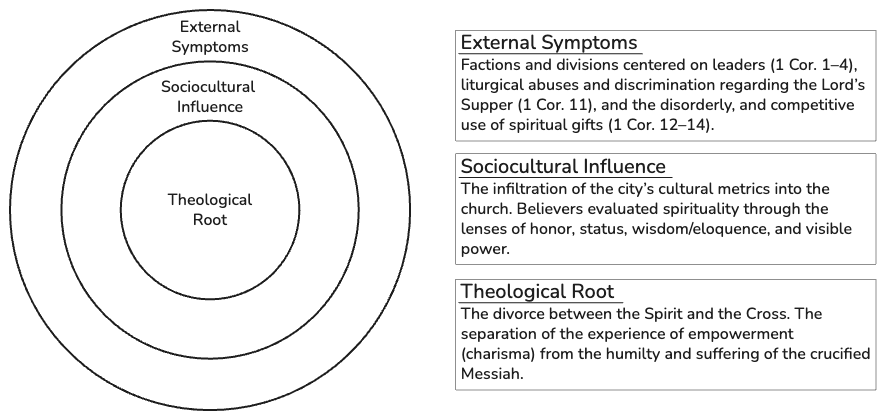
We can visualize the Corinthian crisis (and our own) through three concentric circles:
The outer circle (Visible symptoms): Factions and divisions centered on leaders (1 Cor. 1–4), liturgical abuses and discrimination regarding the Lord’s Supper (1 Cor. 11), and the disorderly, competitive use of spiritual gifts (1 Cor. 12–14).
The middle circle (Sociocultural influence): The infiltration of secular cultural metrics into the church. Believers evaluated spirituality through the lenses of honor, status, eloquence, and visible power.
The core center (Theological root): The divorce between the Spirit and the Cross. The separation of empowerment (charisma) from the humility and suffering of the crucified Messiah.
Recibe nuevos artículos en tu correo
Suscríbete gratis a mi publicación en Substack para recibir cada nueva enseñanza y reflexión teológica directamente en tu bandeja de entrada.